









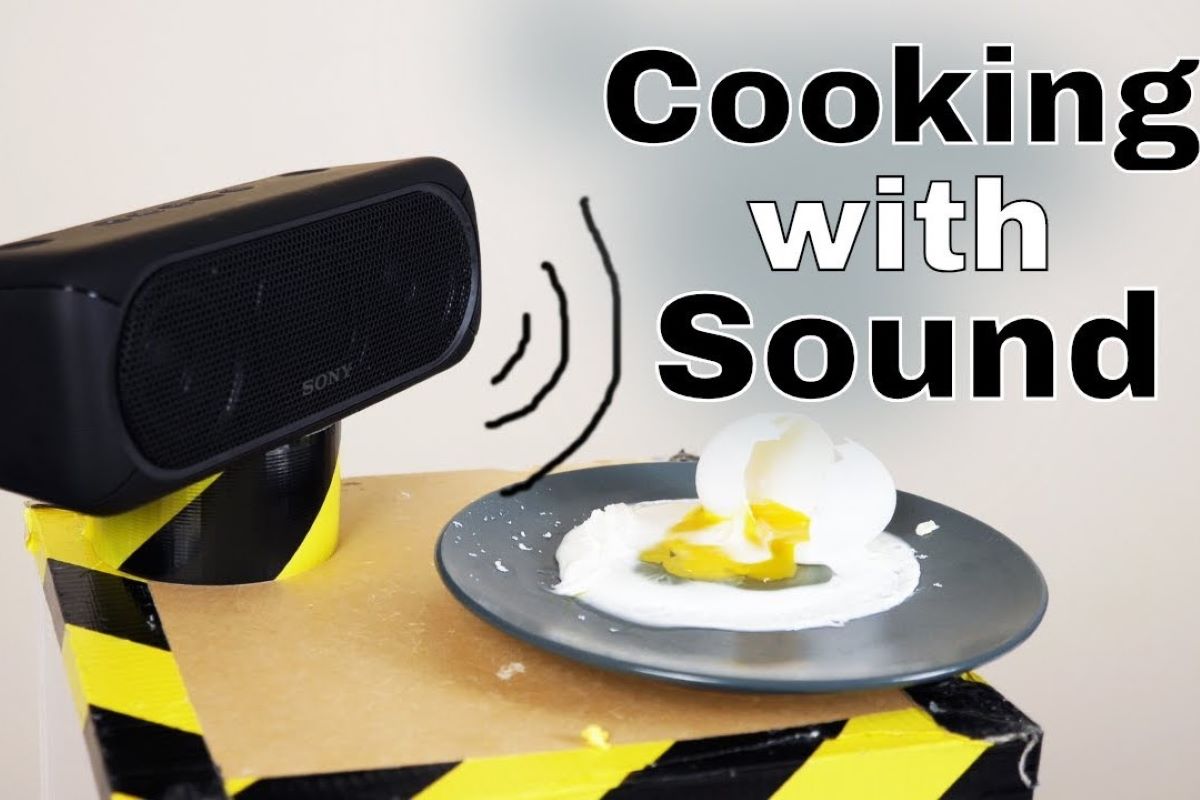
When you hear about cooking, it is usually associated with heat, fire, steam, and ovens. Raising the temperature to transform raw agricultural produce into a more edible, tastier form. For microwave ovens, reheating already prepared meals. However, food technology researchers are already seeing practical potential in the use of an uncommon energy form. The innovative energy form in focus is the guiding principle behind sonic cooking.
Sonic cooking uses ultrasound in food processing. Before the advent of this innovative cooking method, ultrasound had almost no practical application in food science. Meanwhile, ultrasound has enjoyed prominent use in medical imaging and ultrasonic cleaning. Just in case you are already wondering if this involves replacing stoves with speakers or turning sound into a novelty ingredient, think again. Instead, it’s a research-driven approach to non-thermal processing rooted in food physics and engineering. Read on to understand how sound waves and food interact at a structural level.
What is Sonic Cooking, Really?
In the late 19th century, Nikola Tesla, the great inventor, suggested he could transmit electricity across vast distances without wire connections. He was laughed to scorn by many. While wireless power transmission does not supply power to homes today, you probably juice up your latest smartphone through induction charging.
The analogy to Tesla’s technological predictions pops up here because it is easy to dismiss the possibility of cooking with sound. Most claims about cooking with sound easily fall apart when definitions get fuzzy. Now, it is necessary to state upfront that audible sound, the kind we hear, has almost no effect on food texture modification or thermal treatment. To cook with sound, you would need much higher frequencies.
Ultrasound, typically above 20 kHz, operates beyond human hearing and carries enough mechanical energy to disrupt the cellular structure of food items. These frequencies are already used in medical imaging and industrial cleaning. In experimental cooking, ultrasound does not cook food the way heat does. It does not brown, bake, or boil. What it does instead is introduce controlled mechanical stress that can modify texture, accelerate mass transfer, and improve processing efficiency. So, sonic cooking is not the thermal cooking you are familiar with.
ALSO READ: From Natural Pigments to Edible Dyes: The Science Coloring Our Food
The Physics of Sound Waves in Food
Sound travels as a wave of compression and expansion, like pushing and pulling on a material very quickly. Consequently, food molecules are squeezed together, then get spread apart, over and over again. In the air, this kind of compression often reaches our ears. Meanwhile, in liquids and solids, it moves directly through the material. When ultrasound passes through a liquid food system, it creates rapid pressure fluctuations. These changes can disturb droplets in emulsions, weaken cell walls in plant tissues, or alter how proteins are arranged.
A helpful way to picture this is to imagine a still pond. Imagine having thousands of invisible pulses rippling through it every second. Even if the surface looks calm, intense movement is happening at a microscopic level. That movement is what makes acoustic cooking technology useful in food engineering
Acoustic Cavitation: Where the Real Transformation Happens
At the heart of ultrasound processing is acoustic cavitation. In a liquid, the ultrasonic waves pass through, and tiny bubbles are formed during low-pressure cycles. These bubbles grow and then collapse violently. Their collapse generates tiny zones of extreme conditions which cause brief spikes in temperature, intense pressure, and strong shear forces.
These effects are highly localized and short-lived. They do not heat the entire food, but they are powerful enough to rupture plant cells, unfold proteins, and accelerate chemical and physical interactions.
How Food Scientists Use Ultrasound
Researchers use ultrasound to improve emulsification, creating finer and more stable sauces and dressings. It accelerates marination by helping salts and flavor compounds penetrate food tissues. In addition, ultrasound could also enhance the extraction of flavors, pigments, and bioactive compounds from plant materials, often reducing solvent use and processing time.
In protein-rich food items, ultrasound can modify texture and tenderness by weakening structural components. The mechanisms of ultrasound food texture modification are getting frequent feature in food physics and food engineering journals. This is a testament to the growing popularity of these sound phenomena in experimental food processing.
Does Sonic Cooking Replace Heat?
Despite the phrase “sonic cooking,” ultrasound does not replace thermal cooking. Sound waves alone do not reliably destroy pathogens or fully denature proteins in a way that ensures food safety. Texture modification is not the same as cooking. So, food science dispels the notion that sonic is actual cooking.
In practice, ultrasound works as a complementary tool, often paired with mild heat or pressure to improve efficiency while protecting quality. Sound assists processing. It does not take over.
Ultrasound in Experimental and Culinary Research
Experimental gastronomy has helped translate these ideas beyond engineering labs. Programs such as Harvard’s Science & Cooking explore ultrasound-assisted infusions, texture control, and precision processing as ways to demonstrate physical principles in food.
These experiments are not about spectacle. They are about understanding how energy moves through food systems and how structure responds.
Experimental and Culinary Uses of Sound in the Kitchen
In experimental kitchens and university food labs, sound means controlled ultrasound applied with precision equipment. The goal is control over structure, extraction, and texture. The way sound waves and food intersect in real culinary experimentation is described as;
1. Sonic Assisted Infusions
Infusions normally rely on time, heat, or agitation. Think of steeping herbs in oil or soaking botanicals in alcohol. Ultrasound can speed this up.
When ultrasonic waves pass through a liquid, cavitation disrupts plant cells and improves solvent penetration. Aromatic compounds move more quickly into the surrounding liquid. What might take hours at room temperature can sometimes be significantly shortened under controlled ultrasonic treatment. The advantage is not just speed. Lower temperatures can help preserve volatile compounds that might be lost with heat.
In a research kitchen, this opens the door to rapid development of flavored oils, spirits, syrups, or extracts without prolonged heating.
2. Texture Manipulation in Emulsions
Texture is everything in modern cuisine. Mouthfeel, stability, and creaminess, this all depend on how droplets and particles are arranged. Ultrasound can reduce droplet size in emulsions more effectively than simple whisking or blending. Smaller droplets mean smoother texture and often greater stability.
For chefs working at the edge of molecular gastronomy, this allows fine-tuning of sauces, foams, and dressings without relying solely on added stabilizers. The sound energy acts as a mechanical structuring tool.
3. Controlled Protein Modification
In laboratory settings, ultrasound has been used to alter protein structures. Under controlled conditions, it can affect how proteins unfold or interact, influencing gel strength or tenderness. In a culinary setting, this might translate to subtle modifications in texture, especially in emulsified or protein-rich systems. However, precision is critical. Too much energy can damage the structure instead of improving it.
This is why these applications remain mostly in experimental environments rather than restaurant kitchens.
4. Accelerated Marination and Flavor Penetration
Some research kitchens explore the use of ultrasound in assisted marination. Cavitation enhances mass transfer, helping flavors penetrate more efficiently into meat or plant tissues.
The benefit here is uniformity and reduced processing time. It does not replace traditional marination entirely, but it can make it more efficient under controlled conditions.
Limits, Risks and Misconceptions
Ultrasound processing has real constraints. Equipment is expensive. Energy use must be carefully managed. Effects vary depending on food composition and structure. Poor control can damage texture or degrade sensitive compounds.
These limitations explain why sonic cooking has not entered home kitchens in any meaningful way. Without precise control, results are inconsistent.
ALSO READ: The Truth About ‘High-Protein’ Labels: What Food Science Really Says
Is Sonic Cooking the Future of Food or a Specialized Tool?
Ultrasound processing is unlikely to change how we cook dinner at home. But in food science and industry, it already plays an important role.
By reducing processing time, limiting heat damage, and improving extraction and texture control, ultrasound offers a more precise way to work with food. Sonic cooking, stripped of hype, is not a revolution. It is a focused, well-studied tool that shows how sound, used carefully, can reshape food processing from the inside out.
Conclusion
Sound is a powerful but often misunderstood form of energy. When applied as a high-frequency ultrasound, it can reshape food at a microscopic level through acoustic cavitation and controlled vibration.
Sonic cooking is less about “cooking” and more about engineering structure. It enhances emulsification, accelerates extraction, and modifies texture in ways that heat alone cannot always achieve. Thus, its real value lies in precision and efficiency, not novelty.
We may still rely on heat to roast and bake. But in research labs and processing facilities, sound waves are quietly shaping the future of food engineering, one microscopic bubble at a time.
ABOUT THE AUTHOR

Damilare Afolabi is a Research and Data Analyst with a strong academic and applied background in Food Science. He is a content strategist for Quill of Grubs, and occasionally serves as a contributing author.