









Thinking hard enough would probably remind you of at least one food ritual peculiar to your culture, family, or religion. Interestingly, some folks have spent most of their lives with minimal exposure to other cultures. Such individuals may find foreign cultural eating practices a little bizarre. For instance, what would you make of drinking fresh cow blood, or getting told off for eating French fries with your hands? Drinking of cow blood is commonplace among the Masai tribe, while always eating with utensils is an unspoken rule of Chilean commensality.
So, across cultures globally, meals are seldom about nutrition alone. Some communal food traditions involve symbolic eating and social bonding through eating rituals. While some cuisines have undergone modernization over the years, the cultural eating practices that accompany them are likely to persist. This, of course, depends on the community’s proactivity in preserving tradition.
Read on to have a grasp on food anthropology and how symbolic meals influence ritual and identity. Who knows, you may even be able to link your childhood cultural food traditions to current meal trends in your immediate family or community.
What Are Food Rituals?
Food rituals are behaviors that govern how food is prepared, ordered, or consumed. Some meals are ritualistic in that they are only prepared occasionally and for symbolic purposes. The endgame of symbolic eating is usually to recreate some religious or cultural memory, improve the eating experience through social bonding, or to manage anxiety during multiclass and cross-generational commensality.
Lenten and Ramadan fasts and the feasts at their climax are good examples of religious food rituals. Exchanging sweet desserts as gifts during the Indian Festival of Lights is a popular cultural food ritual. During gatherings to celebrate the Chinese New Year or formal dinners, a whole fish features prominently in the main course. The host at such a gathering would often set the table such that the fish head points at the oldest person or a respected guest. All these commensal practices are not just random, but symbolic.
Food anthropology reveals some distinguishing attributes of food rituals. Often, symbolic meals or communal food traditions are time-bound. This means there are designated times for their observance. Another characteristic is that they vary across geographical zones and belief systems. Finally, food rituals build on the history of communal meals and are conducted based on agreed-upon rules and meanings.
It is easy to mistake these ritual meals for food habits. However, while they may sometimes overlap, these two concepts are largely different. Food habits are repetitive, and people do them without giving much thought to what or how they eat. Unlike communal food traditions, food habits can be influenced by a combination of culture and personal preference. Eating with chopsticks is an example of a food habit.
ALSO READ: The African Spice Routes: How West African Flavors Shaped Global Cuisine
Ancient Roots: Food Rituals in Early Societies
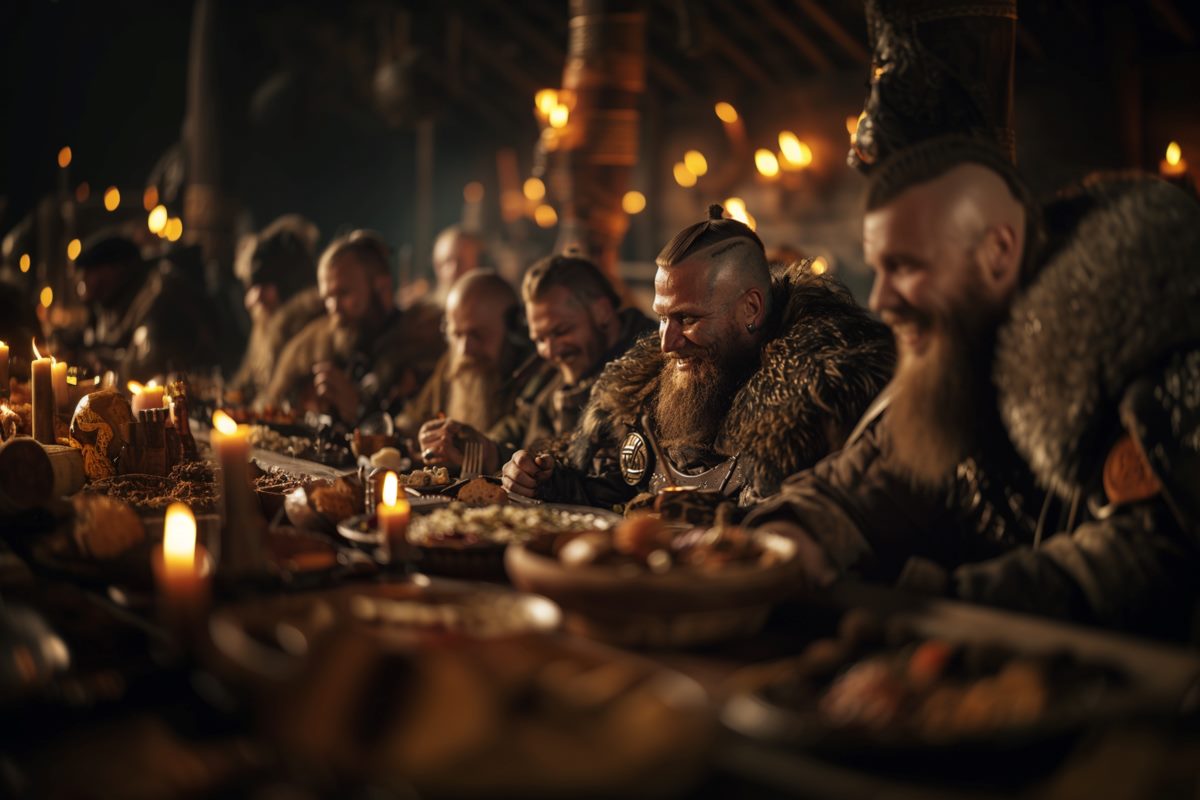
Medieval feasts and banquets provide insights into what communal food traditions were like during early civilizations. Communal feasts served as a social bonding event that strengthened political, religious, or social ties. According to Aeon, these feasts have existed as far back as the Iron Age, the Bronze Age, and the Neolithic Age. Unprecedented events like a bumper harvest may inspire a feast. In other cases, medieval feasts were intentional events that required years of planning.
Another ancient communal practice involving food is ritual offerings and sacrificial meals. These meals transcend the realm of just food and identity and possess spiritual connotations. Indeed, such ritual meals usually symbolize gratitude, atonement, or covenant to a divine entity. There’s the Passover in Judaism, the Lord’s Supper in Christianity, and Qurbani (or Udhiya) in Islam.
Food-growing communities around the globe often hold festivals to celebrate postharvest abundance. Today, these festivities are mostly reenactments of the lavish communal feasts of ancient times. Back then, traditional preservation methods did little in preventing food wastage, so ancient feasts justified pushing the limits. However, modern civilizations know better and have become more discreet with the consumption of farm produce. Consequently, some cultures still mark harvest celebrations only for tradition preservation. The New Yam Festival in West Africa, Thanksgiving in North America, Oktoberfest in Germany, and Chuseok in South Korea are examples of harvest celebrations.
One likely reason why communal feasts and harvest festivals survived cultural changes across generations is the social bond and collective identity they foster.
Food Rituals and Identity Formation
Food traditions instil a cultural memory in people across multiple social domains. Over time, these rituals become traditions that you self-identify with. Unlike food habits, they are not products of preference, but of intentional ritual and identity. Here are three common food-related rituals that influence your identity.
Trans-generational Recipes
If you are a fan of Quentin Tarantino’s Inglorious Basterds, then you probably remember the French family in the movie’s opening scene. The Jew Hunter, played by Christoph Waltz, flattered the patriarch of the family about the quality of the milk he was offered. The correlation? Some families have mastered the art of preserving, producing, or preparing certain meals or dishes, and have passed them down to subsequent generations.
Religious Dietary Laws
Some communal food traditions enjoy strong religious influence. Beyond taking a meal, these rituals serve as a daily reminder of faith, strengthening the cord of spiritual and moral discipline, and reinforcing communal connections across generations. Take the avoidance of alcohol or alcohol in Islam. Some religious dietary practices serve as a daily reminder for minority diasporans, just as Jews observe Kosher.
National and Regional Food Customs
Very little needs to be said in support of how local food customs influence dietary rituals and identity formation. You only need to look around you to see the varying levels of intentionality with which certain foods are handled across different geographical locations. Take pasta as an example, it is a food item of renown across the globe. However, many people now identify pasta with Italy, despite the food item not having origins there. Also in Italy, it is considered a culinary crime to break spaghetti before cooking. This is a popular culinary identity of Italians.
Everyday Rituals: The Power of the Ordinary Meal
Have you noticed that some of your colleagues always start their workday with a cup of coffee? Maybe you are guilty of this ritual. Of course, moderately indulging in coffee every day to stay sharp is not inherently bad. However, it sheds light on how much impact some of these dietary rituals have on our identity.
Another example is families that always make it a point to have dinner together. A young chap who misses the evening meal in such a family must have a very good excuse for doing so. You wouldn’t need a soothsayer to predict that such family rituals will influence the kind of adults children raised in such homes would become. Ordering pizza on Friday nights or eating street food could be a dietary ritual in some families.
Whether cultural, religious, or regional dietary rituals, trust humans to probe and question the status quo. Once the repetition is justified and accepted by the adherent, the ritual becomes the norm.
Food Rituals Under Threat in the Modern World
Many of the food-related rituals have been fast-fading in recent years. The fast-paced lifestyle of the AI age has disrupted several social constructs globally. Families now struggle to function as a unit as individualized eating becomes popular.
Then there’s the case of how globalization and homogenization are forcing individuals across geographical regions to lose their culinary identities. The internet has made the world a global village, and intercultural communication more frequent. By extension, the subtle adoption of foreign culinary cultures and practices is now commonplace. For instance, fusion desserts and dishes are becoming the order of the day.
Nonetheless, some ritual meals remain resilient. Instead of getting swept away by the tides of modernity, some of these rituals are simply adapting to the times.
ALSO READ: Climate Stress Is Changing What’s in Our Food — Not Just How Much We Grow
Why Food Rituals Still Matter Today
The intersection between ritual and identity remains a relevant point of discussion. It is undeniable that many of these culinary rituals have undergone various degrees of modification. Still, they serve as a demarcating line for collective identity.
Young folks, particularly those in the diaspora, get to reconnect with their cultural roots thanks to culinary rituals. In some families, such food-centric rituals are the remaining strings of social cohesion holding members together.
To some extent, food rituals can be acknowledged as aiding mental well-being. Imagine an Asian graduate student studying for a doctorate at a Dutch University. They are likely to adapt better to the new environment if they often get invites to gatherings where Asian meals are served.
Individuals, families, and communities that teach culinary rituals to younger generations are appropriating cultural continuity. Also, culinary ritual is one thing that the old and young generations of a community can share with minimal friction.
Key Takeaway
Food rituals are an active expression of culture. From communal feasts to cultural or filial culinary traditions, these rituals can serve as effective anchors of identity. Endeavor to identify the culinary rituals peculiar to your family, community, religion, or culture, and find ways to preserve not just the recipes, but their symbolism.